 Log in







4 public comments

Finally we are able to close the political cartoon deficit that has been open since Smoot-Hawley.
Greenlawn, NY

Sigh...
New York, NY

More, please.
Lexington, KY; Naples, FL


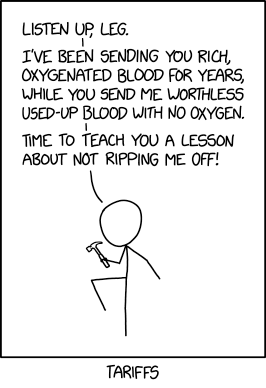
"You legs may have a comparative advantage at running, but we arms have a competitive advantage at swinging hammers, so unless you accept that we're the dominant limbs and stop hogging the oxygen, that running advantage won't be around for long."

Q. I wish to leverage my home equity line of credit (HELOC) to invest in dividend-paying investments. How would you advise I approach this? Is this an effective tax savings tool? Is there any financial institution or products you would advise?
– Martha
A. You know, Martha, in some circles leveraging—or borrowing to invest—is a taboo subject. I find that funny, because there is much less controversy when people borrow to:
- Buy a car, which depreciates in value;
- Buy a house, which normally appreciates, but can decline;
- Take a vacation as a lifestyle investment.
So why is there controversy around borrowing to invest? Probably a lack of understanding, coupled with the fact that when leveraging goes bad, it’s not good.
Let’s talk about leverage. If you borrow $100,000 at 5%, what rate of return would you have to earn on your investments to break even? Would you guess 5%?
Most people would agree with that answer; it sounds logical, right? I mean, if you borrow $100,000 at 5% and paid $5,000 in interest costs then that would mean you would have to make $5,000 on your $100,000 investment to break even, which is 5%. Got it? Good.
But that answer is wrong!
The break-even return on investments is lower than the borrowing cost when you take into account:
- Simple vs. compound interest over time;
- The interest tax deduction and;
- The tax deferral on the investments.
Still skeptical? Consider a free trial of Talbot Stevens’ leverage software to see for yourself. (Here is a demonstration of the software.)
When you make annual interest payments on a loan, this is considered simple interest. For example, in the first year, you would pay $5,000 in interest charges on a $100,000 loan at 5%. In the second year, you’d have the same interest charge because the loan is still $100,000. If you plotted your total interest payments over time on a graph you would see a straight line sloping up toward the right.
Contrast that with a $100,000 investment earning 5%. After the first year, you’ll have $105,000. In the second year you’ll have $105,000 plus 5%, which brings the running total to $110,250—and up it goes each year. This is compound interest, which would produce a graph that curves upward toward the right.
To summarize that point: when you make annual interest payments on a loan, simple interest applies, whereas investments compound. The longer you hold the investments, the greater the compound effect and the lower the return needs to be on the investments to break even.
Now, let’s consider the tax deduction. When you borrow money to invest, the interest cost is considered a carrying charge on your tax return, which creates a tax deduction no different than an RRSP contribution. Looking at this in concrete terms, if your marginal tax rate is 30%, your after-tax cost of borrowing is 3.5%. Now, as with any strategy, I’d recommend you take the tax savings and invest it or pay down non-tax deductible debt. The benefit of investing the savings earned through your tax deduction is not just that you potentially build more wealth, but that it becomes easier to measure the success or failure of the leveraging strategy. Many people look only at the value of the leveraged investments and forget about, or discount, the value of the tax deduction. You need to account for the value of the tax deduction to get a full picture, and reinvesting it is a simple way to do that.
The final point is the tax efficiency of your investments. The less tax you pay on your investments as they grow, the more money you have invested, and the more the return compounds over time. With that in mind, do dividend-paying investments make sense? What’s your reason for selecting dividend-paying investments? Is it because you feel those investments are safe and provide good returns? That’s an OK reason, but if you could find investments with a similar level of risk and rate of return which paid less in distributions/income, then you may be better off from a tax perspective.
Were you thinking of using the dividends to pay some of the interest charges? You can do that but I wouldn’t advise it. Don’t do leverage unless you can easily make the interest payments out of your regular cash flow.
Here are a few things to consider:
- Use a separate HELOC for your source of investing funds. This will make your taxes easier.
- Hold a separate account just for the leveraged investments; again, this will help with tax accounting.
- While you’ll want to invest according to your specific profile, one possible strategy is to buy broad market index investments.
- Don’t use systematic withdrawals from the investment to make interest payments.
- Plan to invest for 10 years or more.
- Remember, leveraging magnifies returns up and down. If your $100,000 goes to $80,000 and you have to sell, you will still owe the bank that “lost” $20,000 (the difference between the $100,000 you borrowed to invest, and the $80,000 value of your investment when you sold).
Finally, when it comes to leverage don’t think just about investment accumulation but also think about how you can use the interest tax deduction. Here are a few quick thoughts:
- Will it reduce your income so you can get more of the Canada Child Tax Benefit, GIS, OAS, and the Age Credit?
- Will the tax deduction offset the tax owed on RRIF or INVESTCO withdrawals?
- Can you use the tax deductions to pay off your mortgage faster and accumulate investments i.e. the Smith Manoeuvre.
- Interest on the interest that is tax deductible is also tax deductible so consider paying off non-tax-deductible debt before making interest payments on your leveraged loan.
I hope I’ve given you some things to think about Martha and I haven’t made it look like everyone should run out and start leveraging. If you have the cash flow, borrow within your means, stick to a broad market investment, and have a long time horizon, you’ll greatly improve your odds for success.
Allan Norman is a certified financial planner and Chartered Investment Manager with Atlantis Financial Inc. in Barrie, Ont. He can be reached at alnorman@atlantisfinancial.ca
This commentary is provided as a general source of information and is intended for Canadian residents only. Allan offers financial planning services through Atlantis Financial Inc.
MORE FROM ASK AN INVESTMENT EXPERT:
- Why having a short memory can hurt investment returns
- How to use ETFs in your child’s RESP
- The best TFSA investment for a time horizon of 3 to 5 years
- She’s 34 and wants to retire at 65 with $70,000 a year. Can she?
The post Using a HELOC as an investment strategy: not as taboo as you might think appeared first on MoneySense.
When I started my Sustainable Economist blog in 2012, there were only a small handful of socially responsible and green Exchange Traded Funds (ETFs). With so few options available, it was challenging to create model portfolios that were properly diversified. My, how times have changed! It feels like new sustainability ETFs are coming out all the time, and now my challenge is to stay on top of them all.
For those new to this type of investing, socially responsible investors encourage corporate practices that promote environmental stewardship, consumer protection, human rights, and diversity. Some avoid businesses involved in tobacco, alcohol, gambling, pornography, fossil fuel production, and guns.
This year, I’m introducing two new model portfolios for those looking for an investment strategy that takes into account both the financial strategy and the social/environmental good to bring out a positive change in our world. I outline them below.
The Vanguard Cheap & Easy ESG Portfolio
| Asset Class | Allocation | ETF Name | Ticker | MER | Currency |
| US Equity | 30% | Vanguard ESG U.S. Stock ETF | ESGV | 0.12 | USD |
| Int’l Equity | 30% | Vanguard ESG International Stock ETF | VSGX | 0.15 | USD |
| Gov’t Bonds | 40% | Vanguard Canadian Government Bond Index ETF | VGV | 0.28 | CAD |
I’ve long admired Vanguard’s unique ownership structure and their mission to keep fees low for investors. Imagine my excitement when they launched their new ETFs with a socially responsible mandate. I even got to write about their pros and cons for MoneySense at that time.
This portfolio is by no means perfectly sustainable, but it is hyper diversified and very cheap with a total Management Expense Ratio (MER) of just 0.19%. It is a step in the right direction for people who want to dip their toes into sustainable investment strategies. Curiously, Vanguard’s Canadian Government Bond ETF (VGV) is not the cheapest Canadian government bond ETF on the market so investors can lower their total MER to 0.15% by swapping it out for less expensive options offered by BMO and iShares.
The iShares Impact Portfolio
| Asset Class | Allocation | ETF Name | Ticker | MER | Currency |
| Canadian Equity | 15% | iShares Jantzi Social Index ETF | XEN | 0.55 | CAD |
| US Equity | 15% | iShares MSCI KLD 400 Social ETF | DSI | 0.25 | USD |
| Int’l Developed Equity | 10% | iShares ESG MSCI EAFE ETF | ESGD | 0.2 | USD |
| Int’l Emerging Equity | 5% | iShares ESG MSCI EM ETF | ESGE | 0.25 | USD |
| Impact Equity | 15% | iShares MSCI Global Impact ETF | SDG | 0.49 | USD |
| Canadian Bonds | 30% | iShares 1-10 Year Laddered Government Bond Index ETF | CLG | 0.17 | CAD |
| Impact Bonds | 10% | Oikocredit GIC / Term Deposit | 0 | CAD |
iShares has long been a leader in socially responsible ETFs, having created the Canadian flagship Jantzi Social Index ETF (XEN) back in 2007. More recently, they’ve expanded their lineup of socially responsible ETFs. I expect more to launch in the coming years as Blackrock CEO Larry Fink sees sustainable investing as a massive trend, and predicted in a recent interview that it will become “a core component of how everyone invests in the future… We are only at the early stages”.
Slightly more expensive with a total MER of 0.28%, this approach is for investors who want to go beyond ‘doing less evil’ by carving out part of their portfolio for investments that are ‘doing more good’. It includes the iShares MSCI Global Impact ETF (SDG), which invests in companies that provide goods and services aligned with the United Nations Sustainable Development Goals. It also includes the Oikocredit GIC/Term Deposit, an amazing investment that generates a stable financial return while providing micro-loans to entrepreneurs and co-ops in emerging economies. The Oikocredit GIC is available to Ontario investors through Kindred Credit Union and the Oikocredit Term Deposit is available to B.C. residents through Vancity.
Tim Nash is Founder of Good Investing, an investment coaching firm that empowers everyday people to manage their own money according to their values.
MORE ABOUT ETHICAL INVESTING:
- Invest your conscience
- Is ethical investing good for your portfolio?
- Community bonds explained
- Ethical investing gets a bad rap
The post Two simple and cheap portfolios for responsible investors appeared first on MoneySense.
Vanguard Investments Canada Inc. has announced the listing of three new low-cost Asset Allocation ETFs that give investors one-stop shopping to the firm’s globally diversified strategies. This is a significant move that not only creates a smart, low-fee, all-in-one portfolio but will also act as a challenge to the rise of so-called robo advisors.
In essence, the middle (Balanced) of the three Asset Allocation ETFs is the equivalent of the global balanced fund, which I’ve argued in the past should — in theory anyway — be the only investment fund you need. Similarly, while Vanguard’s ETFs are invariably components of the robo-adviser services out there (along with BlackRock iShares), any of these three new ETFs could serve as a one-size-fits all alternative to them. It also compares with Franklin Templeton’s Quotential.
The difference is that at 22 basis points and change, the three Vanguard products are quite a bit less costly: less than half what many robo services charge, which is typically about 50 basis points (half a per cent) plus the underlying ETF fees.
Both investors and advisors are asking for “simple yet sophisticated single-ticket investment solutions that provide well-diversified global equity and bond exposure within a low-cost ETF structure,” says Atul Tiwari, managing director for Vanguard Canada. The new ETFs offer investors three different risk profiles and regular rebalancing.
In effect, each ETF is a fund of funds although Vanguard describes them as having an “ETF of ETFs structure.” Each holds seven existing core Vanguard index ETFs (which I list in the postscript below). Each new ETF of ETFs has a management Fee of 0.22%. Vanguard says that when one of its ETFs invests in underlying Vanguard funds, “there shall be no duplication of management fees.” Spokesman Matthew Gierasimczuk said “There are no duplicate fees beyond the 0.22 management fee, other than a basis point or two for operating expense and the trading fee for buying or selling the ETF.”
RELATED: How to declutter your portfolio
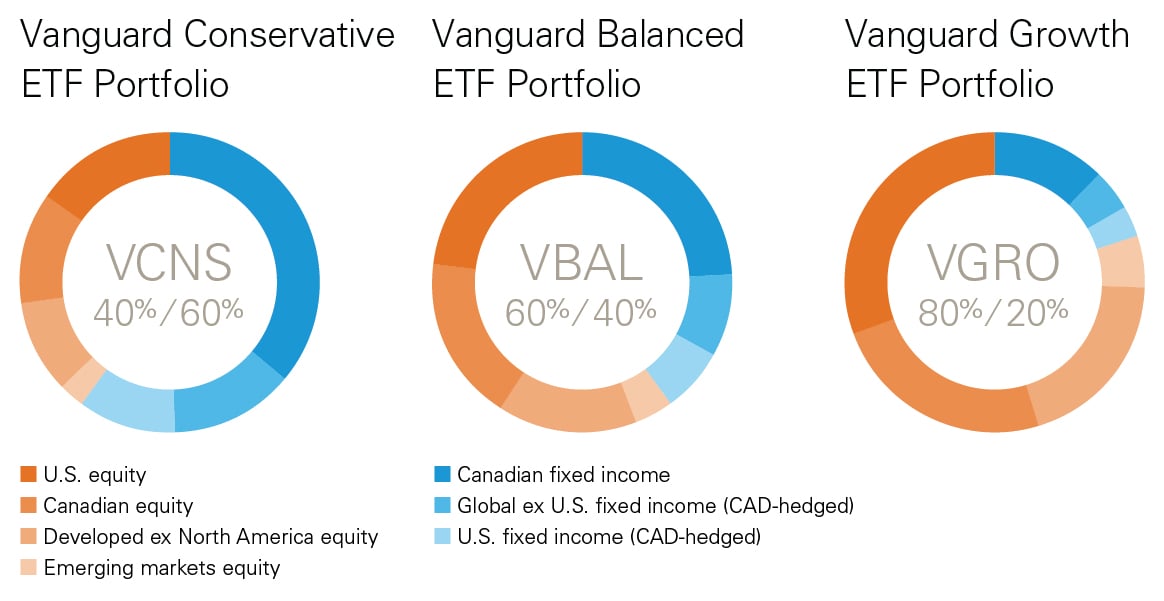
The three asset allocation ETFs cover the normal range from Conservative to Balanced to Growth, as reflected in the product names. Equity weights range from 40% for the Conservative offering, to 60% for the Balanced and 80% for the Growth.
Certainly for do-it-yourself investors who no longer want to be constantly watching the markets and the disparate movements of individual stocks, any of these three new ETFs could be a good substitute and means for getting your life back. Younger people should pick the Growth version with 80% stocks, cautious mid-career people could favour the balanced 60/40% stocks version and older investors and retirees could choose the conservative version with only 40% stocks.
Since it’s arguable even retirees need that high a proportion of stocks to hedge against the possible future ravages of inflation, it too makes sense, although 40% stocks may be a tad high for older retirees. Alternatively, they could put half in the Conservative ETF and another half in ladders of two-year GICs, taking the combined equities down to a very conservative 20%.
It’s not clear to me whether fee-based advisors will flock to these products, although here too it would free them up to do true financial planning, deal with taxes, estate planning and other minutiae. The really good ones might well gravitate to it; the asset gatherers not so much.
Ideal for TFSAs
I also see this as a core holding in Tax-free Savings Accounts (TFSAs), since the $5,500 current annual contribution limit constitutes a relatively small “ticket” and these give you all the world and all asset classes in a single punch of the ticket. The Growth version (VGRO) certainly has healthy exposure to both Canadian and global securities, both stocks and bonds.
According to the fact sheet, it is 30.1% in the Vanguard U.S. Total Market Index ETF, 24% the Vanguard FTSE Canada All Cap Index ETF, 20% in the Vanguard FTSE Developed All Cap ex North America Index ETF, and 5.9% in the Vanguard FTSE Emerging Markets All Cap Index ETF. That’s exposure to the whole world’s stocks. The 20% fixed income comes from 11.7% in the Vanguard Canadian Aggregate Bond Index ETF, 4.7% in the Vanguard Global ex-US Aggregate Bond Index EFF (CAD Hedged), and 3.6% in the Vanguard U.S. Aggregate Bond Index ETF (CAD Hedged). All rebalanced regularly!
Because TFSAs can still be added to into advanced old age — my 101-year old friend Meta still contributes to hers! — I’d lean to going with the Growth or Balanced versions, and view the Conservative one as more appropriate for RRSPs and RRIFs, particularly the latter once forced annual minimum withdrawals commence (and therefore need to generate cash).
Finally, for couples where one spouse is the “finance” person and the other disinterested, this kind of product seems ideal for older do-it-yourself investors who are beginning to worry that dementia and related ills might impair their cognitive skills for investing.
In the case of a financially literate wife and a financially uninterested husband, if the wife were concerned about her dying first and wishing to put the collective portfolio on autopilot, the Balanced or Conservative version might also do the trick, short of just handing the whole lot over to a professional money manager.
Here are the 3 ETFs and their ticker symbols on the TSX:
- Vanguard Conservative ETF Portfolio (VCNS) seeks to provide a combination of income and moderate long-term capital growth by investing in equity and fixed income securities with a strategic allocation of 40% equities and 60% fixed income.
- Vanguard Balanced ETF Portfolio (VBAL) will provide long-term capital growth with a moderate level of income split 60% equities to 40% fixed income.
- Vanguard Growth ETF Portfolio (VGRO) provides long-term capital growth by investing in equity and fixed income securities with 80% equities and 20% fixed income.
In a press release, Vanguard Canada head of product Tim Huver said the ETFs offer “a simplified and scalable solution for financial advisors, and a one-stop globally-diversified and transparent option for investors … Investors can rely on Vanguard’s global investment experts to continuously assess their portfolio’s exposure and rebalance it back to its intended risk level.”
With the three new ETFs, Vanguard Canada now offers 36 ETFs, with C$14 billion in assets under management. Vanguard Investments Canada Inc. is a wholly owned indirect subsidiary of The Vanguard Group, Inc.
A longer version of this story ran at the author’s Financial Independence Hub.
Jonathan Chevreau is founder of the Financial Independence Hub and co-author of Victory Lap Retirement. He can be reached at jonathan@findependencehub.com.
MORE ABOUT ETFS:
- The fallacy of a “stock-picker’s market”
- How to boost your returns in retirement
- Should my teens be investing with a discount brokerage?
- When investing, think like a landlord
- Should I use an ETF that tracks the NASDAQ?
- Should you invest actively or passively in bonds?
- An eye on emerging markets
The post Everything an investor needs in a single ETF appeared first on MoneySense.


So, if I put on a leprechaun costume, there _will_ be one at the end of the rainbow.


Next Page of Stories